Sunday, May 18, 2014

God's Wedding Banquet: Sermon Preached Oct. 6, 2013 - Metro Baptist Church, New York

Sermon Preached Oct. 6, 2013 
World Communion Sunday
Metro Baptist Church
New York, NY

This morning you are invited to a wedding banquet. The wedding in Cana, Jesus’ first miracle! Turning water into wine at a wedding party. Some have argued that the point of this story is that Jesus ministers in small ways, such as helping out the hosts when they’re running low on wine. But might the author of John be up to something more here? And what does a wedding banquet have to do with World Communion Sunday, anyway?

Why would the author choose a story about Jesus turning water into wine at an unnamed couple’s wedding in Cana as the first sign that would reveal Jesus’ glory in this gospel account? Doesn’t it seem just a bit mundane? Were there not bigger needs in Cana that day where Jesus could have put this power to better use?

But what if this story isn’t really about the wedding of the Canan couple? Is the author using the wedding to symbolize something else?

The Bible is full of nuptial imagery and wedding banquets in particular are an important allegory in the New Testament. The apostle Paul uses this metaphor in his letters to the churches in Ephesus and Corinth. And Jesus is repeatedly called the bridegroom, and the Church a bride. This imagery culminates in the last two chapters of Revelation, written around the same time as the Gospel of John, at the wedding of the Lamb, with the vision of the New Jerusalem, dressed as a bride adorned for her husband. 

Could it be that the couple go unnamed in this story in order for us to substitute in our own names? Jean-Calvin, Tiffany, Angie, Alan, Michelle, Anita? Are we in fact the guests of honor at this wedding banquet?

To put it another way, could this story be about God’s desire to enter into relationship with us?

In your own Bible study time I’m sure you’ve noticed that the Gospel of John is a bit different in style from the other three gospels. It’s a bit more poetic - a little more literary version of Jesus’ story. Theologian Marva Dawn puts it this way:

John ought not to be read quickly. It is full of double and triple meanings, endlessly suggestive images, and “signs” that seem obvious on the surface but yield much deeper truth if we are willing to dig contemplatively.[1]

And this mornings’ story is no exception, it is full of allegory, full of possible meanings. Meanings that may help us understand what the author is trying to say about Jesus and God, but perhaps even more importantly, meanings that we might apply to our lives, to our church, and to our faith today.

So, if this story is about God’s desire to be in relationship with us, what is this relationship to be about, what will it look like?

In the second chapter of John there are two stories, and I believe they are key to interpreting each other. The second story, which we didn’t read this morning, is the familiar story where Jesus purifies the temple in Jerusalem by overturning the money changers’ tables. A wonderful scene, Jesus engaged in street theater of divine justice, running the crooks out of the temple.

One clue that these two stories are connected may be the six purification jars that Jesus asks the servants to fill with water. Though we can’t know for sure, it is likely that these jars would have been part of the purification process controlled by the temple authorities, and unlikely that there would have been six of them of this size in someone’s home. And did you notice that they were empty… depleted? And notice that Jesus didn’t reject them, but rather filled them.  Today’s environmentalists might say he repurposed them. The jars, previously used for ritual purification are liberated by Jesus and given a life-giving, celebratory purpose.  When coupled with the purification of the temple, this liberation of the purification jars seems to point to a radical reorientation of the focus of the church, from ritual and purification to liberation and justice.

Another indication that the stories in John 2 are connected is how the author uses the phrase, “on the third day” to frame them.  Verse one literally starts with the words, “on the third day, there was a wedding in Cana of Galilee”. Just 17 verses later, after running the money changers out of the temple, Jesus is asked, “What sign can you show us for doing this? And Jesus answered them, ‘Destroy this Temple, and in three days I will raise it up.’"  The author goes on to make it even more clear by saying that after Jesus was crucified and resurrected his disciples remembered these words and believed. This takes on even more significance because for Jews in the first century, the temple was where heaven and earth met… Jesus seems to be saying that has changed now. He has come to replace the temple. And he has come to bring liberation and justice.

And what about Mary? Were you intrigued like I was by her role in this story? Mary makes two cameo-appearances in the entire Gospel of John, and is never mentioned by name. She plays a pivotal role here at the beginning - at Jesus’ first sign - and she is there at Jesus’ last breath at Golgotha. Is Mary there to help us connect the gift of wine at the wedding banquet, with the gift of Jesus’ life on the cross?

Or is she there to remind us of Jesus’ humanity, that he was born of a human mother, even as he is revealing his divinity by transforming water into wine?Or is she there to simply show us the way. We would all do well from time to time to listen to Mary when she says, as she did to the servants at the wedding banquet: “Whatever Jesus says, you do it.” Now there’s a Bible verse I don’t mind people taking literally!

Or who knows, maybe her voice trembled as she spoke to the servants, wondering if Jesus would really come through. Was she stepping out on faith?… expecting a miracle? Can we approach the challenges we face with that type of faith?

And did you notice that the servants! were the first to understand the sign? Is this mere coincidence or did Jesus purposely choose to reveal himself first to those on the underside of history? Are the humble and impoverished privileged in understanding the signs of the Kingdom of God? Can you imagine the excitement when they went home to their families after the banquet to tell of what they had witnessed? And what must they have felt as they heard of what this same Jesus did a few days later at the temple in Jerusalem?

And how can we be sure we’re not missing out on new signs of the Kingdom today? I know that during my days at Metro I often let my desire to help, outpace my willingness to listen. What rumors of Jesus’ activity did I miss out on by not listening enough to the Damayan Migrant Worker’s Association and their struggle against modern-day slavery? Did I miss a chance to chat with Jesus when he came in the guise of a woman in need of some food for her family or a warm coat in the winter? There’s no doubt for me that each spring a piece of the kingdom sprouts up four floors above your heads on Metro’s roof in the Hell’s Kitchen Farming Project.

And here in Colombia I’m just beginning to learn about the spirituality of urban gardening, resistance and nonviolence as articulated by the network of Anabaptist urban gardens springing up in the poorest and most violent neighborhoods here in Bogotá. I’d love to connect them with the Hells Kitchen Farming Project!

That’s just one concrete idea that I can come up with that would be a wonderful outcome of this World Communion Sunday. But I’m sure you all can think of more. Metro is so blessed to have wonderful connections with other parts of the world such as South Sudan, Brazil, the Philippines, Sweden, Cameroon, the Democratic Republic of the Congo, St. Lucia and of course Colombia, to name just a few.

But before I close, I want to come back to a question I briefly raised earlier about the apparent arbitrariness of turning water into wine and the question of whether there weren’t more important uses for God’s power? I don’t know how the author would answer that question. And it’s no easier to answer why so much suffering still exists today.

But what if we turn that question on ourselves? Have we set our sights too low? Have we grown too accustomed to the injustices around us? What power and energy do we have that can bring healing to the world? Because the Gospel of John seems to be saying that for Jesus, loving God is very this-worldly… it’s not about purification rites, but celebration of love and community, and it’s most definitely about justice! The story of the wedding in Cana teaches that God’s power is present in Jesus… and now through the Communion Jesus has told us that God’s power is with us, through the Holy Spirit. 

And yet we know that many are still excluded from the tables of life… for lack of food, lack of power, lack of justice, from Hell’s Kitchen, to Kinshasa, to Bogotá. But we are also promised that at God’s final banquet all will be invited to the feast…
Welcome to God’s wedding banquet! As you come to the communion table today, do you come as the Bride, or do you come as Mary, or do you come as a servant?… but most importantly do you dare leave as a disciple?… emboldened by the signs that you have seen to go out and effectively love the world? May it be so!


[1] Marva Dawn, Untitled Essay, in Richard Foster, Dallas Willard, Walter Brueggemann and Eugene Peterson, Renovaré Spiritual Formation Bible: New Revised Standard Version with Deuterocanonical Books, (San Francisco:HarperSanFrancisco, 2005) p. 1934.

Friday, May 17, 2013

Urgent Action for Colombian Conscientious Objector Jhonatan Vargas

URGENT ACTION

On behalf of Conscientious Objector Jhonatan David Vargas Becerra, youth leader of the Central Foursquare Church of Barrancabermeja, Santander who was forcibly recruited by the 34th Battallion of Barrancabermeja

“But with righteousness he shall judge the poor, 
and decide with equity for the meek of the earth.” 
Isaiah 11:4a NRSV


Dear Sisters and Brothers,

In Colombia military service is mandatory for all men who have turned eighteen. Yet the Colombian Constitutional Court established in Sentence C-728 of 2009 that conscientious objection to mandatory military service is a fundamental right, in accordance with international norms and treaties on conscientious objection. In spite of this the Colombian Military does not respect this and does not guarantee this right.

As Justapaz, Mencoldes and the CEDECOL Peace Commission we have accompanied several young men who have gone through the process of claiming Conscientious Objector (C.O.) status – young men who for reasons of conscience do not want to serve in the military. We are aware of the irregularities committed by the Armed Forces and to the difficulties C.O.s face when they refuse military service.

We want to share with you Jhonatan David Vargas’ case and request your solidarity.

On March 16, 2013, 18-year-old Jhonatan David Vargas of Barrancabermeja went to the 34th Battallion of Barrancabermeja to establish his military status. Despite verbally communicating his status as a C.O. – that for reasons of conscience he could not provide military service – he was enlisted against his will in the 34th Batallion. He was sent from Barrancebermeja, Santander to a military district of Tolima and later sent to the 28 ASCP Bochica Battallion in Puerto Carreño, Vichada where he currently remains. To date he has refused to swear allegiance.

Since arriving at the Bochica Battallion he verbally communicated to the sargeants and lieutenants that for reasons of conscience and his religious training he firmly believes in God’s word as his guide and faithfully follows God’s command to not kill and therefore he will not carry weapons, will not learn to use them and will not kill. Jhonatan David believes that learning to use weapons and combat techniques violate his religious beliefs. The Bochica Batallion officers have threatened to court martial him for insubordination and disobedience. They have also made fun of the fact that he is a Christian.

Jhonatan David is a university student and is also studying to be a pastor at the Central Foursquare Church of Barrancabermeja’s school of theology.

Colombia’s Military Recruitment Law (Law 48 of 1993) establishes that persons who are in training for religious life or priestly service may request to postpone their military service (line d, article 29). This could apply for Jhonatan, though we seek that his right to conscientious objection, as established in the Constitutional Court’s sentence C-728 of 2009, be recognized.

Requests:
1. Share this information with your organizations and congregations and pray for Jhonatan and his family.
2. Write the Colombian Government demanding the following:
  • That they protect the fundamental right to conscientious objection to military service as established in Sentence C-728 of 2009. That they protect the right to freedom of conscience and religious freedom as established in articles 18 and 19 of the Colombian Constitution which are currently being violated by the National Army’s 28th ASCP Battalion.
  • That they release Jhonatan David Vargas Becerras and grant him C.O. status ending his need for military service.
  • That Jhonatan be immediately returned to Barrancabermeja.
3. Send copies of any letters to justapaz@justapaz.org

Download a sample letter.

Brothers and sisters, your support is crucial because the Colombian government is sensitive and responsive to national and international public opinion, perhaps more than anything else.

We thank you in advance for your support.

Fraternally,
JUSTAPAZ, of the Colombian Mennonite Church
Mencoldes Foundation
Peace Commission of the Evangelical Council of Colombia

Please send letters to:

Dr. Juan Manuel Santos
President of Colombia
secretaria.privada@presidencia.gov.co
Edificio Administrativo: Calle 7 No.6-54. Bogotá, Colombia -
Telefax: (57 1) 562 9300

Dr. Angelino Garzón
Vice-president of Colombia
contactovicepresidencia@presidencia.gov.co
Carrera 8a No.7-57.
Telephones (57 1) 444 2120, 444 2122

Dr. Juan Carlos Pinzón
Colombian Minister of Defense
juan.pinzon@mindefensa.gov.co
Carrera 54 Nº 26 – 25 CAN
PBX 3150111

Juan Carlos Mejía Gutiérrez
Director of Recruitment and Reserves
Av. El Dorado Cra. 52 Can
Conmutador (57) (1) 3150111
atencionalusuario@reclutamiento.mil.co

ASPC Battalion 28 “BOCHICA”
Barrio Mateo Kilometro 1 vía Villavicencio
Teléfono: 0985654504

Dr. Jorge Armando Otálora
Human Rights Ombudsman.
Calle 55 Nº 10 -32 Bogotá, Colombia -
PBX: [57 1] 3147300
defensoria@defensoria.org.co

Wednesday, February 20, 2013

Looking back... looking forward...

I can hardly believe that another year of ministry here in Colombia has come and gone… and what a year it has been! Amidst it all, one of my biggest challenges has been keeping you all informed of what our partners and I have been up to. So as I begin 2013 I want to share with you all some of the highlights of the past year as well as what we are looking forward to this year.

Looking back on 2012

2012 was an exciting year for Colombia, for the work of the Cedecol Peace Commission and for my ministry here.

The Cedecol Peace Commission eagerly entered into a partnership with the Virginia Region of the Christian Church (Disciples of Christ) during 2012. The highlight of this partnership was a visit of four members of the Peace Commission and myself, to Virginia from May 30 - June 13 where we attended the Virginia Disciples Regional Assembly and visited over a dozen churches throughout the region sharing about the Peace Commission’s work.

Following our time in Virginia we travelled to Washington, DC where we were hosted by our partners in the Central Atlantic Conference of the United Church of Christ and held successful meetings with numerous faith-based justice organizations, the State Department, several congressional offices, the US Institute for Peace and even held a congressional briefing on the state of churches in Colombia in the midst of the armed conflict.

Upon returning to Colombia in July I was asked to begin working full-time with the Peace Commission’s Prophetic Call human rights documentation program. Our goals there continue to be to document the impact of the armed conflict on Protestant and evangelical churches in Colombia, to provide material, spiritual and legal support to the victims and to advocate for governmental policies - both in Colombia and from the US - that support victims and bringing an end to the armed conflict. 

In late 2012 we published the short-format Prophetic Call annual report with cases from 2010 and 2011 and as of right now are working hard to get the long-format reports published in both Spanish and English. These reports, which bear witness to the hundreds of human rights violations suffered by members of our churches as well as the positive responses to the conflict from our churches, can be found at www.apropheticcall.org

We continued to accompany the farming communities of El Garzal, Las Pavas and a group of 12 farming communities in southern Córdoba Province all of whom face violence in their struggle to keep the land they depend on for survival. We celebrate with the communities of El Garzal and Las Pavas recent decisions from the Colombian Rural Development Institute (INCODER) in favor of the peasants’ ownership of the land.

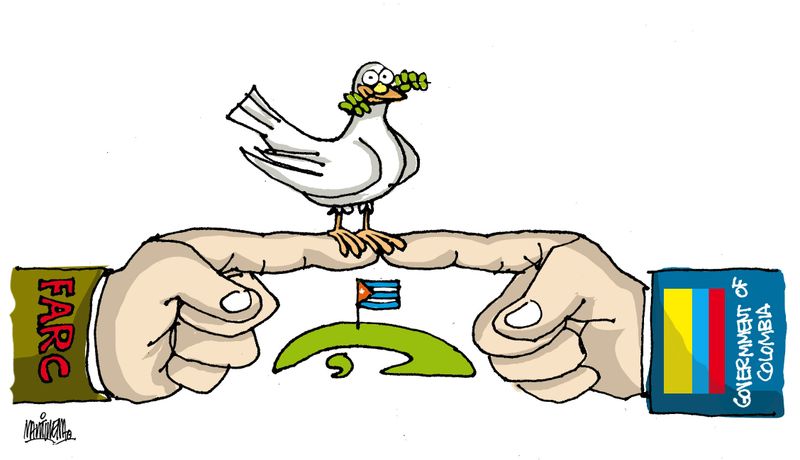
The biggest development in Colombia in 2012 was the beginning of formal negotiations between the FARC guerrilla and the Colombian government seeking to end their armed conflict. This new scenario for peace has invigorated peacebuilding networks throughout Colombia, who in late 2012 scrambled to find ways to contribute to the peace process. As the Cedecol Peace Commission we were delighted to help organize the Peoples Building Peace – International Peace Conference including hosting the Rev. Raúl Suárez of the Martin Luther King Center of Havana, Cuba. Negotiations are ongoing in Havana and we ask all to pray for a positive outcome.

Looking ahead at 2013

In 2013 we hope to continue the work mentioned above – accompanying the victims of the armed conflict, bearing witness to their testimony and creatively seeking to build peace with justice in Colombia.

I personally, and the members of the Cedecol Peace Commission generally, are grateful for the support we receive through the four official partnerships with which we’re blessed: the Central Atlantic and Connecticut Conferences of the United Church of Christ and the Capital Area Region and Virginia Region of the Disciples of Christ. We hope that each of these can be renewed and strengthened in 2013.

We look forward to hosting a delegation from our UCC partners from May 30 – June 9 of this year. There is still space available. Won’t you consider joining? If interested please contact me and/or Charlie Pillsbury of Shalom United Church of Christ in New Haven, CT {chapillsbury@igc.org} for more information.

I am grateful to all those who support my ministry in Colombia in so many different ways. I’ll do my best to stay in touch in 2013 and thank you in advance for your prayers and support!

Tuesday, September 25, 2012

Pray for Peace in Colombia

Pray for Peace in Colombia on Sunday, September 30, 2012

Lectionary Selection: Mark 9: 38 -50

Mission Stewardship Moment from Colombia:
Earlier this month, on Tuesday, September 4, Colombian President Juan Manuel Santos confirmed that the Colombian Government and Colombia’s largest guerrilla group, the Revolutionary Armed Forces of Colombia (or FARC) would begin formal peace talks on October 8th in Oslo, Norway and then continue them in the following months in Havana, Cuba.

Colombians are hopeful that this fourth attempt at ending the 50-year-old armed conflict that has cost so many lives in Colombia may be successful. The last attempted peace process was over ten years ago and ended in failure. Churches across Colombia are praying for peace and ask you to join them.
Colombian churches have consistently been working for peace for many years now. In April, many church leaders gathered for an Ecumenical Summit at the Summit of the People, a parallel gathering to the Summit of the Americas (overshadowed in the US by the Secret-Service sex scandal). The culmination of that meeting was a statement from Colombian religious leaders calling on President Santos to enter into negotiation with the guerrilla groups for peace. The Peace Commission of the Evangelical Council of Colombia called for a wide church gathering on Wednesday, September 27, to discern how the church can best support this new peace process.

The United States is also involved in this conflict. Our government continues to be the largest source of military aid to Colombia, as well as the source country for most of the weapons used by the illegal armed groups – guerrillas and paramilitaries. And the majority of illegal drugs, that provide funding for all sides, continue to flow north in an attempt to meet the seemingly insatiable demands of US consumers. May we now join in prayer and active support for peace in Colombia.

Prayer for Colombia:
Loving God, we have heard rumors of peace in Colombia. We come before you today confessing the violence in our hearts and in our society. And we come before you today asking for peace here and in Colombia. God, you have called us to be the salt and light of the earth… and yet we are often stumbling-blocks along the way. Renew in us our saltiness and help us to reflect your light. We want to be at peace with one another and with our brothers and sisters in Colombia, just as they wish to be at peace with themselves and with us. Through our shared commitment to Jesus Christ we know that our relationship can be about more than guns and drugs. Help us to be at peace with each other. We pray for our sisters and brothers in Colombia and for religious leaders that are working for peace. We join with them today in prayer. Amen.

Wednesday, April 11, 2012

Quick Request: Words of Encouragment

Next week I will be participating in a retreat for victims of the armed conflict in Colombia being organized by the Mennonite Brethren Church in Chocó.

Chocó is one of the provinces with the highest rates of poverty and its citizens have lived through decades of violence from all the armed groups in Colombia.

As part of the workshop we would like to share with the participants words of encouragement from around the world.

Would you take just a minute to write just one or two sentences of encouragement for us to share? Please include your name (just a first name is fine) and your church/city/state.

If you're receiving this via email, you can reply via email... or if you're seeing this on my blog or Facebook, feel free to just use the comments section.

Thank you, thank you, thank you!

Thursday, March 29, 2012

CEDECOL National Assembly, DoPA and Summit of the People

Just got back last night from the 59th Annual National Assembly of the Evangelical Council of Colombia (CEDECOL) in the lovely colonial city of Popayán, Cauca.

Highlights, other than bouncing over the Andes in a Fokker 50, included participating in round-table discussions on Human Rights and Church and State led by Rev. Pablo Moreno and Rev. Jairo Suárez (both members and leaders of the CEDECOL Peace Commission), as well as hearing a sincere thank you from CEDECOL President, Rev. Edgar Castaño, for the important documentation of the Prophetic Call Human Rights Documentation Project.

Yesterday, the Peace Commission went public with the decision to hire a paid National Coordinator. Please pray for the Commission to find the right person to fill this important position; the first time in its 20 year history that the Peace Commission will have a National Coordinator working full-time for the Commission.


In other news, the Peace Commission is once again asking you to join us in the Days of Prayer and Action for Peace in Colombia. You can download worship packet here for worship resources for your church to join us!

Here in Colombia we will be joining with other churches and civil-society organization at the Summit of the Peoples which will offer civil-society alternatives to the Summit of the Americas which will gather the Presidents from across the continent on April 14 and 15. We plan to hold a public peace vigil on Friday, April 14.

Wednesday, January 18, 2012

Video Interviews with Yours Truly

While on home assignment in the United States from May-November, 2011 Global Ministries produced a couple of short interviews with me about my work.

This first video was shot in October 2011, just prior to my return to Colombia for a second term:


This second video was shot in May 2011 just after I had returned to the US after my first term in Colombia: